Articles · Mike Harty · Published 2026-10-24 · Updated 2026-10-24
Reading MT5 Backtest Drawdown: Balance, Equity, Relative
Short answer: an MT5 Strategy Tester report gives six drawdown figures: absolute, maximal and relative, each for balance (closed trades only) and equity (including open positions). For sizing an account, the one that matters is the maximal equity drawdown at your real lot size. The others help explain it.
The six figures, in one real report
From our backtest of a popular MQL5 recovery EA: GBPUSD H1, 1 Jan 2020 to 22 Oct 2026, real ticks (100% quality), $10,000 deposit, 1:500, 0.85 lots (5 orders of 0.17). This is a backtest, not a live result.
| Report line | Balance | Equity |
|---|---|---|
| Drawdown Absolute | $3.00 | $562.08 |
| Drawdown Maximal | $5,062.47 (13.31%) | $8,399.39 (27.88%) |
| Drawdown Relative | 13.31% ($5,062.47) | 27.88% ($8,399.39) |
Net profit for the same test: $80,187.21, profit factor 2.39.
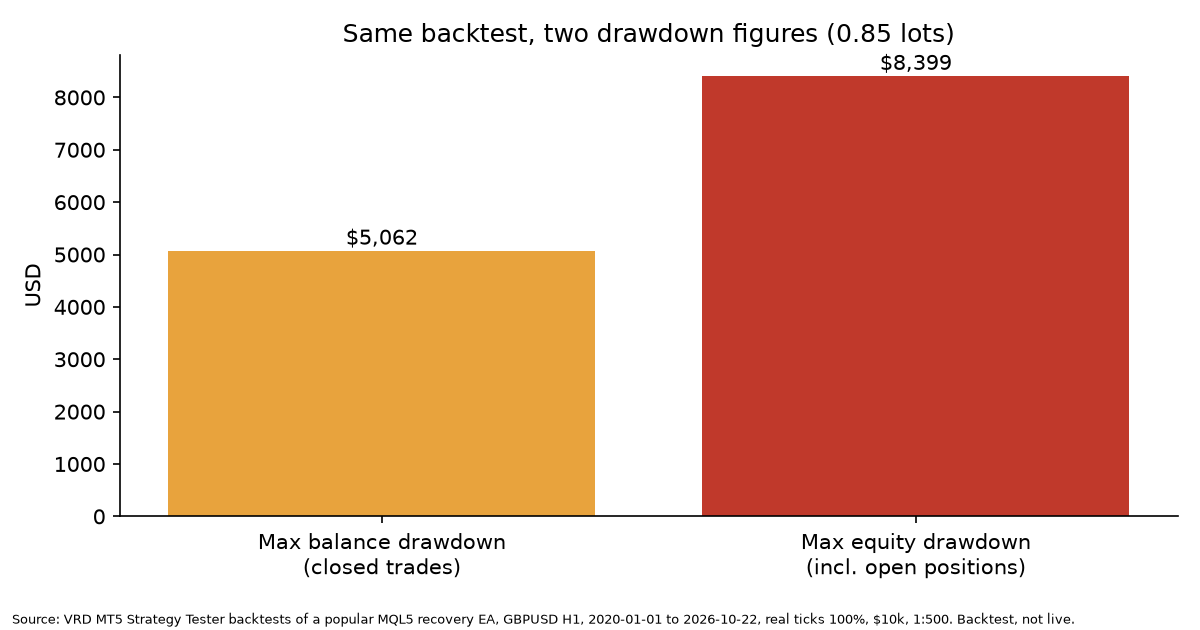
Balance vs equity: why they differ
- Balance moves only when a trade closes. An EA holding a losing basket open shows no balance drawdown until it closes it.
- Equity = balance + floating P/L. It captures the loss you were actually carrying.
- Here, the equity drawdown was 1.66× the balance drawdown. For grid, recovery and multi-order EAs, expect a large gap. A smooth balance curve can hide it.
Absolute: the least useful number
Absolute drawdown measures how far you fell below the starting deposit. This EA was profitable early, so its balance never went far below $10,000 ($3.00). That's no sign of safety; it's an artefact of timing.
Maximal vs relative
- Maximal is the biggest drop in money, with the percentage at that moment.
- Relative is the biggest drop in percentage, with its money value.
- In this test they're the same episode. In tests where the balance compounds, they often aren't: a small early dip can be the largest percentage, while a later, bigger-money drop is the maximal one. Percentages measured on a compounding balance understate the risk to a fixed-size account, so work in money at your own deposit size.
Reading drawdown, step by step
- Check the test was run at your lot size (see how we backtest EAs).
- Take Equity Drawdown Maximal in money.
- Note the date of the episode and how long it took to recover. The report graph shows the dip; MT5 doesn't give the recovery time, so measure it from the graph or an export.
- Add a buffer (we use at least 1.5×), because the future can be worse than the backtest.
- Compare the result with the deposit you planned. See how much capital you need to run an EA.
Live: watch the same numbers per EA
On a live account with several EAs, the terminal shows one blended equity curve. VRD Insight (free) splits results by EA and magic number. Insight's drawdown is calculated from closed trades, which makes it a balance-style figure, so also watch the account's floating loss, or use VRD Guardian to enforce equity limits.
Drawdown is a range, not one number
A report shows the drawdown of one path. Resampling the backtest's baskets 5,000 times gives a range. For the recovery EA above (EA C in our Monte Carlo guide), the resampled P95 was only $2,337, against $8,399 of equity drawdown in the real 0.85-lot report. That Monte Carlo figure is a lower bound: it scales a 0.01 run and uses realised losses for basket troughs. So when the two disagree, trust the bigger number. For a grid EA with a $4,000 floor (EA D), P50 and P95 were both $11,474, and 64% of runs breached the floor. That high blow % means its worst single event is bigger than the floor. It is not a forecast of how often the account will blow.
Start free: VRD Insight
Begin with VRD Insight, the free per-EA tracker for MT5, sold through the MQL5 Market. When you need more: VRD Guardian ($79) adds loss limits per account and per EA, VRD Quant ($69) turns a backtest into a capital plan, and VRD Complete ($149) gives you all three plus EA Passports and a central reserve.
Guardian makes a best-effort attempt to limit losses and protect an account in difficulty using predefined rules. It cannot guarantee that losses will be avoided or that an account can be rescued. Gaps, slippage, broker or connectivity failures can prevent rules executing. Trading carries a high risk of loss.
Frequently asked questions
What is the difference between balance and equity drawdown in MT5?
Balance drawdown counts only closed trades. Equity drawdown also counts the floating loss on open positions, so it's usually larger and is the figure to size your account from.
What is maximal drawdown in an MT5 report?
The largest fall from a peak to a later low, in money, with the percentage at that point in brackets. MT5 reports it for both balance and equity.
What is relative drawdown in MT5?
The largest peak-to-low fall as a percentage, with its money value in brackets. It can come from a different episode than the maximal money drawdown, especially when the balance grows over the test.
What is absolute drawdown?
How far the balance or equity fell below the initial deposit. On a profitable test it's often tiny and tells you little about risk.
Which drawdown should I use to size my account?
The maximal equity drawdown at the lot size you will trade, plus a buffer, because the next drawdown can be deeper than the backtest's worst.
One EA blowup costs more than the whole suite.
VRD Complete contains single-EA blowups and frees capital you have parked as idle buffers. $149 at launch pricing.